
Happy 250th America: The Titans of Hospitality

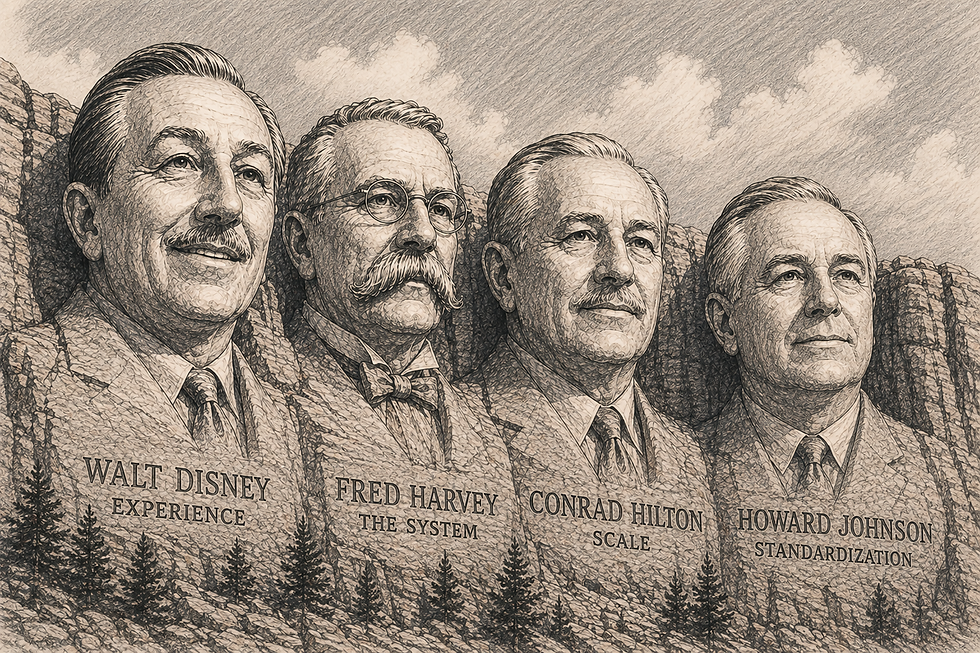
As America celebrates is 250th birthday, this is the perfect time for reflection. I know I've been thinking a lot about the state of hospitality, experience, leadership, and communication across the country as this milestone has approached.
Certainly, during this coming month we will celebrate our founding fathers, presidents, industrialists, and military heroes - and with good reason. But there is another group I want to call attention to.
The people who taught America how to serve, how to welcome, and how to embrace experience. Washington, Jefferson, and Adams secured this nation - and Harvey, Hilton, and Disney made it more hospitable.
These titans taught us that hospitality could be present anywhere
They showed us that repeatability was key to trust
Each brought a flavor all their own to details, process, and people
I have spent a lifetime in hospitality - driving customer experience, leading teams, implementing standards, and building trust with guests. All of us in the hospitality business should understand where our standards came from and why what we do matters.
Throughout the history of the United States, we have been a culture that pushes boundaries, yearns for what is around the corner, and innovates along the way. These Titans of Hospitality were the revolutionaries of service and the frontiersman of experience.
The idea for this article hit me when I discovered the first two Titans on our list when I visited the Grand Canyon last year. So let's jump in and meet the heroes of this story.
Fred Harvey - Hospitality on the Frontier
In 1876 the West was very wild. Train passengers were dumped at depots in the middle of nowhere and the food they were given was not much more than greasy slop served by surly cooks with barely enough time to finish before being shoved back onto the train to continue their journey.
That is where Harvey, who immigrated from England in 1850, came in - as a former restaurant cook and a seasoned railroad traveler, he knew it could be better. Working with the Santa Fe Railroad, he built restaurants and hotels that gave travelers confidence. His restaurants were clean, had white tablecloths, and served on real china. He hired and trained a corps of server in formal uniforms, paid a real wage, and expected high standards of service. His "Harvey Girls" were the first nationally trained service workforce in America, during a time when the country had not figured out how to integrate women into the workforce. Together, they civilized the west.
He may have also piloted mobile ordering, with his 4 minute standardized service times during train stops. Conductors would telegraph in guest orders ahead of time to keep the service moving and blow the train whistle when they were 5 minutes away from the station so orders could be prepared.
His company went on to bring high quality culinary experiences with fresh food to the South rim of the Grand Canyon. His legacy lives on today within the Xanterra travel corporation.
The Takeaway: Standards build trust with guests - Harvey invented the idea that a traveler in Kansas deserved the same respect as a diner in New York City.
I discovered the legacy of Fred Harvey and Mary Colton during a trip last year to the Grand Canyon. They were the most impactful hospitality professionals that I had never heard of before - and their legacy inspired me to write this article.
Mary Colter - Inspiring Feeling Through Design
Mary Colter was ahead of her time as a ground breaking architect starting with the Fred Harvey company in 1902. For 38 years she served as their chief architect and designed how you felt when you stepped off the train and into a Harvey property.
She built the Hopi House and Hermit's Rest at the Grand Canyon - and she refused to try to make it look like an East coast hotel. Rather she resisted the European look in favor of native materials, craft, and stories embedded in the structure. Her buildings, like the famous Bright Angel Lodge, immersed you in the experience of visiting the West - a concept that Walt Disney would make famous 50 years later. She was known for rubbing soot over a new hearth to age it or to embed metal supports inside of stone pillars - modern touches disguised within designs that felt at home on the frontier.
The Takeaway: Every experience needs to be designed intentionally to support the customer journey and the feeling you are trying to evoke from guests.
Howard Johnson - Orange Roofs You Could Trust
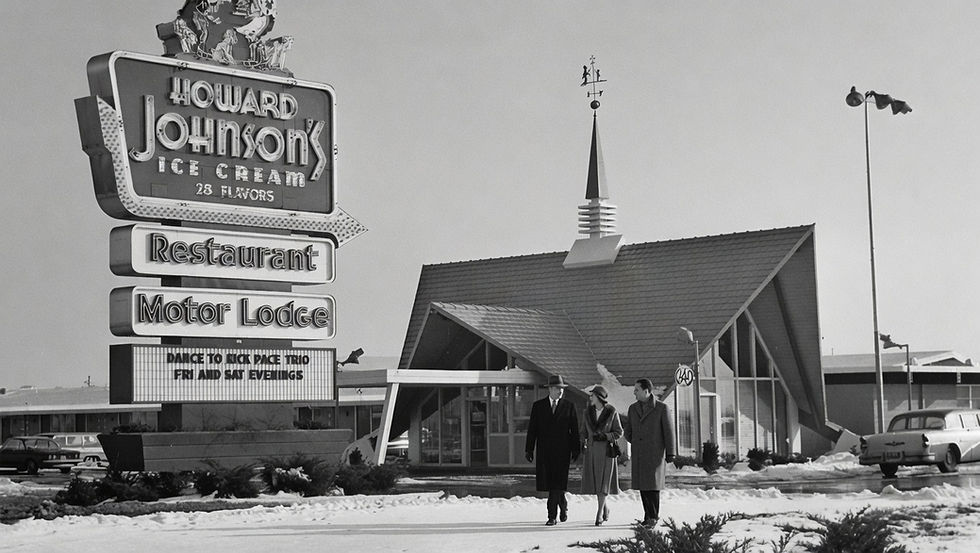
50 years later, railways had given way to interstate car travel following the second World War. Howard Johnson was a Boston Area entrepreneur who ran a single soda fountain with 28 flavors of higher quality ice cream than his competitors.
He realized there was an opportunity to make guests feel comfortable as they traveled across the country - with an orange roof as the focal point. At the time, motorists didn't know if their next dinner was going to be a treat or give them food poisoning. The orange roofs, standard menus, good service, and unmistakable weathervane were easy to see from the road and brought familiarity to weary travelers.
Before the decline of the brand, Johnson had 500 motor lodges and 1000 restaurants in 42 states.
The Takeaway: Consistency is hospitality and putting guests at ease is a superpower. He put on a masterclass in branding and brand consistency.

Conrad Hilton - Globalizing American Hospitality
Hilton believed scale didn't have to erode the soul of a brand. He started with one hotel in Texas after running boarding houses in New Mexico. He believed that hospitality could be a global language and wanted someone staying in Dallas or halfway around the world to have the same experience.
Hilton proved that growth doesn't require sacrificing quality and his vision was to fill the earth with warmth and hospitality.
His idea of scaling his business was built around bringing people together.
He did this through standardization, reliability, and an idea of affordable luxury. I've long been a Hilton fan, and I've been a diamond member myself for a decade. I have traveled around the world, and for me I do feel that familiarity of walking into a Hilton lobby across the US and the globe.
The Takeaway: Hospitality is a superpower that can put guests at ease after a hard day and change people's days for the better.
Walt Disney - Hospitality as Storytelling
After his success in motion pictures and animation, Walt set out to create a destination where parents and children could enjoy the day together. He tired of the dirty fairs and carnivals of the day and struck out to invent a new type of experience.
He ushered in the idea experiential hospitality and immersive experiences long before we knew what those words meant.
Walt built Disneyland with intentionality and hospitality - every decision was made with the guest in mind and through the lens of storytelling. He placed benches where guests would need them, trash cans so they would be used, and key visual cues like Cinderella Castle so you could always get your bearings. The modern theme parks that use the hub-and-spoke model (a centralized location with areas branching off from that point) owe Disney a thank you.
The Takeaway: Immersive experiences and storytelling are powerful ways to create and sustain guest loyalty.

Truett Cathy - Hospitality as a Value
Cathy opened the Dwarf Grill in Georgia in 1946 and there invented the famous boneless fried chicken sandwich we know today. He built Chick-fil-A around that sandwich but also around a set of values that put him slightly out of step with the rest of the restaurant industry. Today you still see in how they close on Sundays, even with their fans begging them to open.
Cathy's focus on consistency is to be applauded, but his people are what make the brand. They are extremely selective about their owner-operating partners and the front line employees they select to work in their stores. Not many other quick service restaurants take the time put flowers on the table, refill drinks, or bus your trays.
The Takeaway: Giving guests an extra 10% can set you apart from other brands in a crowded hospitality market - especially when you start with the right team.
Howard Schultz - Inventing the Third Place
Howard Johnson created a whole new category that has nothing to do with coffee. He realized when he starting working for Starbucks in the early 80s that America had lost it's hang out spots, which used to be diners and soda fountains. During a trip to Italy he put the two together seeing the way people gathered in their vibrant espresso bars.
Today Starbucks is synonymous with the experience that wraps around the product - the ambiance, seating, music, and wifi - a comfortable place that isn't work or home, but a distinct third place.
Coffee is truly a way to look at our economic development in the U.S. We moved from selling the beans as a commodity to roasting and selling as a product. From there we moved to brewing and selling coffee with a bit of service, and today we have wrapped an entire experience around what's in the cup.
Starbucks is at a crossroads now - with pressure from small local brands and a customer base who wants mobile ordering and pick up, but bemoans the loss of personalized service. They are working to find their way as the idea of "service" and "speed" continue to evolve.
The Takeaway: Operational excellence and hospitality are not the same thing, but you need both to be successful. Execution and service go hand in hand to delight guests.

George Jenkins - Our Florida Hospitality Hero
No list written in the Southeast would be complete without talking about Publix. As a proud Lakeland, Florida resident I'd be remiss to not mention its founder and the impact this brand has on our area. Publix is as synonymous with Florida as Disney and palm trees.
After leaving the Piggly Wiggly organization, he set out to start something new. When he founded Publix in 1930, he wasn't simply building another grocery store. He was creating a place where people enjoyed shopping and where associates were treated with dignity and respect. Long before "customer experience" became a business strategy, Jenkins believed that every customer deserved to be greeted warmly, helped willingly, and thanked sincerely.
His philosophy was remarkably simple: if you take care of your people, they'll take care of your customers.
That belief became woven into the culture of Publix and remains one of the reasons the company consistently ranks among America's most admired retailers. It is also one of the largest employee-owned companies in America.
The Takeaway: How you treat your team is how they will treat guests - and that will be the perception of your brand and your service.
There is so much we can learn from these Titans of Hospitality. They forged a path that we all walk in hospitality and we stand on their shoulders everyday as we serve guests. Sure, some of these brands have dwindled, transformed, or disappeared entirely - but that doesn't minimize their impact and what we can learn.
We stand on the edge of the new economy in hospitality - Transformation. The experience economy is moving toward something more outcomes based and ROI driven. How does the experience make guests feel and how does it change them for the better on the other side? How does it make a customer better, faster, stronger, happier, or more relaxed or connected? Those are the questions that brands must be asking now.
Hospitality is an American art form - we didn't invent the hotel, restaurant, or theme park, but we did invent the franchise, the scale, and the experience. We have embraced the act of making strangers feel welcomed and creating loyalty with guests.
The next 250 years won't be won with automation, AI, or efficiency - those are table stakes already. They will be won by those who design service around people, for people, and by people, maximizing human connection and integrating innovation.
This is how you will keep the legacy of these titans at the center of everything you do.
Happy birthday, America.
Tony Johnson
* Crafted with care + intentionality by a real human, not A.I.

Tony is an award winning speaker and author on the topics of sales growth, customer experience, and leadership. Tony speaks to thousands annually and has been featured on ABC News and Fox News. He is available for business planning, motivational keynotes, leadership workshops, and employee service skills training.
Tony is the founder of Ignite Your Service + Consulting and the Co-Managing Partner, Co-Owner, and Chief Experience Officer for 4xi Global.
Tony is available to help with your Customer Experience and Employee Engagement Strategies, inspirational keynote talks, team training and development, and executive leadership coaching.
* (C) 2026 The Tony Johnson, LLC. May not be used to train A.I.


Comments